









How News Sources Portray Trump Imeachment Policy
This chart shows how major news sources across the ideological spectrum frame trump imeachment policy, from left to right-leaning perspectives.













Trump’s impeachments have been one of the most polarizing and partisan issues in contemporary politics. Media bias has exacerbated the polarization of many issues, as more people are susceptible to biased news. Most, if not all, Republicans oppose the impeachments, while Democrats support them.
Impeachment refers to the process by which a legislature’s lower house brings charges against a civil federal officer, the vice president, or the president for misconduct alleged to have been committed. The general impeachment process features a two-stage process where the House of Representatives brings charges (called impeaches) and the Senate tries those charges. The House votes on articles of impeachment, which requires a simple majority of over 50%, and the Senate holds a trial requiring a two-thirds majority for conviction.
Trump Impeachment Timeline
There have been two impeachment trials that President Donald Trump has undergone. The Trump impeachments refer to the 2019 impeachment for abuse of power and obstruction of Congress, and the 2021 impeachment on charges of incitement of insurrection.
President Trump was first impeached in December 2019, when the House of Representatives adopted two articles of impeachment against Trump: abuse of power and obstruction of Congress. The Senate held a trial in February 2020, where it voted to acquit Trump on both articles of impeachment, meaning that the prosecution failed to prove that Trump was guilty beyond a reasonable doubt of either charge.
Trump was impeached for the second time in January 2021. The House adopted one article of impeachment against Trump: incitement of insurrection. Those in the Senate who opposed the article argued that it was unconstitutional to try a former president instead of a current officer. The vote passed the House, reaching a majority of over 50%, but failed in the Senate in February 2021.
Trump Impeachment Charges
The 2020 conviction charges (abuse of power and obstruction of Congress) were prompted by Trump’s solicitation of foreign interference in the 2020 U.S. presidential election to aid his re-election bid, and his obstruction of the inquiry by instructing his administration to disregard subpoenas for documents and testimony, according to a formal House inquiry. The inquiry reported that Trump withheld military aid from Ukrainian President Volodymyr Zelenskyy in an attempt to influence Ukraine into announcing an investigation into Joe Biden and his son, Hunter Biden. The inquiry also reported that Trump promoted a discredited conspiracy theory that Ukraine (not Russia) was behind interference in the 2016 presidential election.
The 2021 charge of incitement of insurrection sought to address Trump’s attempt to overturn the 2020 presidential election results, such as his claims of election fraud in Georgia, and the insurrection that took place on January 6, 2021, at the U.S. Capitol. The article claimed that Trump encouraged the January 6 insurrection before it occurred, and also argued that the Constitution permits disqualification from holding future office.
Trump is the only U.S. president and only federal official to be impeached twice, though each charge failed in the Senate after being passed in the House. Two other presidents have been impeached by the House of Representatives, but acquitted by the Senate: Andrew Johnson and Bill Clinton. Johnson was impeached for violating the Tenure of Office Act, and Clinton was impeached for perjury and obstruction of justice after an affair.
Republican Stance on Trump’s Impeachments
Republicans tend to oppose both impeachments, as Trump is a strong Republican. 88% of Republicans and Republican-leaning independents oppose Trump’s 2021 conviction, and 10% favor it. These numbers were consistent with the 2020 impeachment trials.
Republicans opposed Trump’s first impeachment largely by arguing that the process was unfair, partisan, and unsupported by sufficient evidence. They claimed Democrats were trying to remove Trump for political reasons rather than because of a clear constitutional violation. In the Ukraine case, many Republicans argued there was no proven quid pro quo, that Trump had legitimate concerns about corruption in Ukraine, and that even if his actions were inappropriate, they did not rise to the level of an impeachable offense.
Republicans opposed the second impeachment by arguing that convicting Trump after he had left office was unconstitutional or improper, even though many legal scholars disagreed. More broadly, opposition to both impeachments was shaped by partisan loyalty, fear of backlash from Trump’s supporters, and the belief that impeachment required a broader national consensus than Democrats had achieved. In short, Republicans viewed the impeachments as politically motivated, legally weak, procedurally flawed, and harmful to the country’s political stability.
Politicians Who Oppose Trump Imeachment

88% of Republicans and Republican-leaning independents oppose Trump’s 2021 conviction, and 10% favor it.
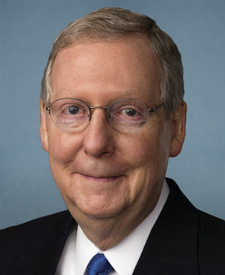
Mitch McConnell
“This partisan impeachment will end today. ... [The case is] a symptom of a much deeper pattern of considering the presidency to be illegitimate under Trump.”

Lindsey Graham
“The House impeachment process seeks to legitimize a snap impeachment totally void of due process. No hearings. No witnesses. It is a rushed process that, over time, will become a threat to future presidents. ... The last thing the country needs is an impeachment trial of a president who is leaving office in one week.”
Democratic Stance on Trump’s Impeachments
Democrats generally support both impeachments – 89% of Democrats favor the 2021 conviction, and 7% of Democrats oppose it. In 2020, however, 81% favored it and 17% opposed it.
The House votes for each impeachment trial were nearly party-line. The 2020 Trump impeachment Senate vote was 52-48. The Senate vote for the 2021 conviction was 55-45, with all Democrats, both Independents, and five Republicans voting in favor of the impeachment. The conviction would need 67 votes in favor of the impeachment for a conviction to take place.
These data make the Trump impeachment trials a very polarizing issue, as nearly all Republicans oppose them and nearly all Democrats support them.
Politicians Who Support Trump Imeachment
89% of Democrats favor the 2021 conviction, and 7% of Democrats oppose it.

Nancy Pelosi
“Our founders' vision of a Republic is under threat from actions from the White House. That is why today, as Speaker of the House, I solemnly and sadly open the debate on the impeachment of the President of the United States. If we do not act now, we would be derelict in our duty. It is tragic that the president's reckless actions make impeachment necessary. He gave us no choice.”
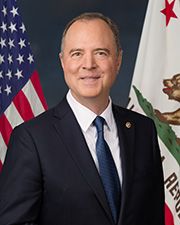
Adam Schiff
“Guarding against a president who undertakes official acts with the corrupt motive of helping himself is at the heart of the impeachment power. ... The matter is as simple, and as terrible as that. Our answer to these questions will affect not only the future of this presidency, but the future of the presidency itself, and what kind of conduct or misconduct the American people may come to expect from their Commander-in-Chief.”
Trump Impeachment Today
New polling conducted in April 2025 suggests that over half (52%) of all American voters support a third impeachment of President Trump. Most independents (55%) support an impeachment, with 38% strongly supporting it and 28% strongly opposing it. Democrats, however, are largely in favor of a third impeachment, as 68% strongly support it and only 9% strongly oppose it. Republicans, unsurprisingly, strongly differ; 8% of Republicans strongly support, and 71% strongly oppose. In total, 37% of Americans strongly support the impeachment, while 38% strongly oppose it.
Democrats and Republicans are nearly flipped on this issue. The percentage of Republicans who support it (8%) is nearly identical to Democrats who oppose it (9%) and vice versa. Additionally, 46% of respondents said that “Democrats in Congress should attempt to impeach Trump because they have a duty to remove a president who has violated Americans’ constitutional rights and the law.” 38% said that Democrats in Congress should not, because Trump hasn’t done anything that warrants an impeachment.
However, a Trump impeachment today is unlikely, as the Republican Party holds the majority in both the House of Representatives and the Senate. This makes it nearly impossible for an impeachment against a Republican president to pass in both chambers. Reaching a two-thirds majority is difficult as-is, but adding partisanship to the equation makes it extremely difficult for a third impeachment.
As of July 2025, there have been several unsuccessful impeachment attempts against President Trump. Most notably, Democratic Representative Al Green proposed to impeach Trump over the U.S. strikes on Iran, charging him with abuse of power. The proposal quickly failed in a vote of 344-79 in the House. Out of the 344, 128 were Democrats who voted with Republicans against the resolution.
To learn more about biases and party affiliation, visit www.biasly.com. Biasly also offers a Premium Membership for an in-depth analysis of current news and access to bias analytics, discussions, and more.
