









How News Sources Portray Universal Basic Income Policy
This chart shows how major news sources across the ideological spectrum frame universal basic income policy, from left to right-leaning perspectives.









Despite all of the greatly polarizing and dividing topics seen in contemporary politics, some are less polarizing than others, one of which is Universal Basic Income. Media bias or biased news, however, may cause issues such as UBI to become increasingly partisan. Democrats tend to support UBI, while Republicans tend to oppose it.
Universal Basic Income (UBI) is a system proposed by the Democratic Party where all citizens regularly receive money from the government, regardless of their employment status or income level. It’s meant to reduce poverty, ensure individual economic stability, and stimulate the economy. UBI is a strongly debated topic and a highly partisan issue. It became a cornerstone of Democratic presidential candidate Andrew Yang’s campaign, proposing a $1,000 monthly stipend for every American over the age of 18. Some have traced UBI back to early American thinkers, such as Thomas Paine and Milton Friedman.
UBI approval varies by political affiliation, gender, and age. Polling reveals that just 65% of Democrats and 28% of Republicans support UBI. Based on gender, 43% of men and 52% of women support it, while 54% of younger Americans versus 38% of older Americans support UBI.
Democratic Stance on Basic Universal Income
The Democratic stance often stems from the belief that UBI could help address wage stagnation, economic insecurity, and job losses caused by automation. The idea gained visibility in Democratic politics through figures such as Andrew Yang, whose presidential campaign centered on UBI, and through broader debates about how to respond to a changing economy. However, Democratic support is not universal: some prominent Democrats have been cautious or skeptical. For example, Hillary Clinton wrote that UBI was “exciting but not realistic” because funding it would require either large new taxes or cuts to other programs. Other Democrats, such as Sen. Bernie Sanders, were described as supportive, while others preferred alternatives such as expanding the earned income tax credit, job training, and universal basic skills.
Politicians Who Support Universal Basic Income
65% of Democrats support universal basic income.
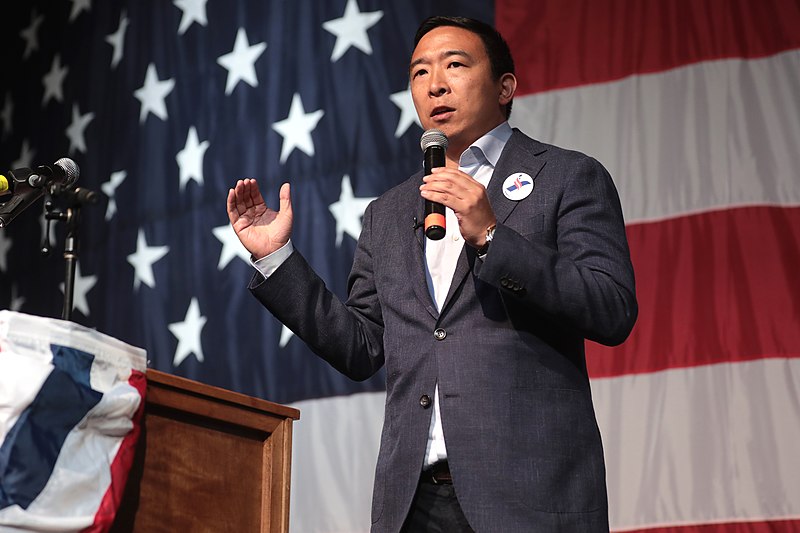
Andrew Yang
“The most direct and concrete way for the government to improve your life is to send you a check for $1,000 every month and let you spend it in whatever manner will benefit you the most. The government is not capable of a lot of things, but it is capable of sending large numbers of checks to large numbers of people promptly and reliably. We have plenty of resources, they're just not being distributed to enough people right now. Let's build a new kind of economy – one that puts people first.”
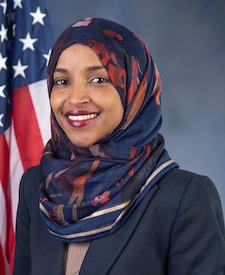
Ilhan Omar
“Poverty is a choice. For too long we have prioritized endless growth while millions are homeless, hungry, or without healthcare... The pandemic has laid bare these inequalities. We as a nation have the ability to make sure everyone has their basic needs like food, housing, and healthcare met.”
Republican Stance on Basic Universal Income
Many Republicans oppose Universal Basic Income because they see it as a major expansion of government spending, taxation, and federal power. Since UBI would provide cash payments to everyone regardless of income or employment status, critics argue it would be extremely expensive, increase deficits, require higher taxes, and possibly contribute to inflation. They also tend to prefer targeted welfare programs over universal benefits, arguing that limited public funds should go to people with the greatest need rather than to all citizens, including those who are already financially secure.
Republican opposition is also rooted in beliefs about work, personal responsibility, and limited government. Many conservatives argue that assistance programs should encourage employment and self-reliance, while UBI’s unconditional nature could reduce work incentives or create dependency on government payments. In short, Republicans typically oppose UBI because they view it as costly, inefficient, redistributive, and inconsistent with their emphasis on work, markets, and smaller government.
Politicians Who Oppose Universal Basic Income
28% of Republicans support universal basic income.

Ken Paxton
“This program is a 'Harris handout' and a socialist experiment... Handing out unearned public funds with absolutely no strings attached violates the Texas Constitution. It represents a fundamental misunderstanding of the role of government and unfairly redistributes the hard-earned money of working taxpayers.”
John Wiik
“If you get people addicted to just getting a check from the government, it's going to be really hard to take that away. These programs are a one-way ticket to government dependency... It amounts to bureaucrats trying to hand out checks to make sure that your party registration matches whoever signed the checks for the rest of your life.”
Basic Universal Income: Pros and Cons
Some universal basic income consequences include that it would disincentivize work, increase taxes, and may serve as a temporary fix for reducing poverty. By guaranteeing people a basic income regardless of their employment status, it may decrease the number of people in the workforce. Everyone will have a basic income, which may disincentivize work. In turn, this may reduce economic growth and lead to a less productive society, as fewer people join the workforce. UBI also means that the government would entirely fund the monthly stipends to American citizens. To ensure that the government has the money to do so, they would likely increase taxes or cut existing programs to afford this monthly expense.
UBI mainly serves to benefit those in poverty or with an unstable income. However, critics argue that it serves as a temporary fix, as UBI would most likely only be implemented during specific presidencies and revoked if another president opposes it. Additionally, UBI could increase dependence on government assistance. Those who don’t have a source of income because they quit their job, were receiving a monthly stipend, or didn’t have one to begin with, may depend on this monthly stipend to survive.
Pros of UBI include improved health and well-being, stimulating the economy, and addressing systemic racial and gender issues. By providing a monthly stipend to everyone, those in need of the stipend the most will be able to afford healthier foods (or more food in general), which would decrease overall hunger and increase the health/well-being of the population. Furthermore, the monthly stipend would improve mental health by reducing stress related to money and financial insecurity. One economic benefit of universal income is that it would boost the economy by providing consumers with increased disposable income, which could lead to increased spending and demand.
Those in poverty in the U.S. are disproportionately composed of minority groups, as Native Americans, African Americans, and Hispanic Americans all have a poverty rate higher than the national average, descending from the highest to the lowest poverty rate. Single-parent families, especially those headed by single mothers, have significantly higher poverty rates than families with married couples. Because these groups are the most vulnerable, UBI would help them the most, therefore addressing systemic racial and gender issues.
Should the U.S. Implement a Universal Basic Income?
While the U.S could implement a Universal Basic Income, it’s unlikely that the government will pass legislation for one anytime soon due to partisanship. Most Republicans oppose UBI, and because the current government is Republican-controlled, it’s unlikely that any legislation concerning UBI will be approved. If a Democratic candidate such as Andrew Yang were to be elected, it’s certainly possible that UBI could be implemented. Even with a Democratic president, both sides of the Universal Basic Income arguments have valid concerns.
However, a better alternative could be a Guaranteed Basic Income. Moderate Republicans and Democrats may be able to agree on implementing GBI versus UBI.
Universal Basic Income versus Guaranteed Basic Income
Guaranteed Basic Income is a system where only certain individuals who meet requirements regularly receive money to help them meet basic needs and improve financial stability. It’s a form of social welfare that provides and promotes financial stability, regardless of work status. This differs from UBI in that not all people receive regular stipends to assist them; rather, it’s only the people who need the extra money the most. This mainly includes those in poverty, as they are the most in need. As stated above, this tends to be minorities (Native Americans and African Americans) and single parents.
Guaranteed Basic Income may be a better alternative to UBI, as it addresses some of the concerns surrounding UBI. First, it would be cheaper than UBI because not everyone would receive the stipend, which would significantly cut costs for the government. By only providing money to those in need, it could decrease the disincentivization to work, as a) there are fewer people to disincentivize, and b) these people may be well-aware that without the stipend, they would require a job to survive. People in poverty may have multiple jobs to sustain their lives (a case where GBI would act as an extra bonus), or they may be single parents who do not have the time to work or cannot pay for someone to watch their child.
All in all, UBI still remains a somewhat polarizing and partisan topic, though less dividing than others. Moderate Republicans and Democrats may be able to reach an agreement when it comes to a basic income, whether that may be universal or guaranteed.
To learn more about biases and party affiliation, visit www.biasly.com. Biasly also offers a Premium Membership for an in-depth analysis of current news and access to bias analytics, discussions, and more.
